
SaaS Is Not Dead. 12,631 Founder Requests Say What Changed.
The SaaS obituary is wrong about the market and right about the business model. Here is what 12,631 recorded founder requests show about who still pays.
By Elliot Naff · November 6, 2026 · 4 min read
Every few months someone writes the obituary again. SaaS is dead. AI ate the application layer. Nobody pays for software anymore. The posts get shared, because the fear is real and the argument is easy to repeat.
We hold a library of 12,631 ideas collected from public founder communities between May 2025 and November 2026. It is not a survey, and it does not prove a market. It does show what people keep asking for. The record says the obituary is wrong about half of its claim, and uncomfortably right about the other half.
The demand did not disappear
If software demand were collapsing, the requests would stop. They did not. The library holds records for every month from May 2025 to November 2026, and the requests kept arriving in the same places.
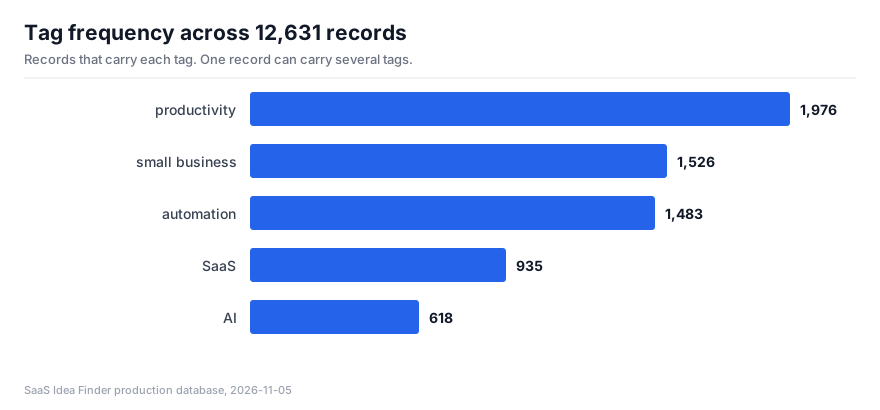
Ten communities account for the whole library. Productivity requests are the largest group at 1,976, followed by small business at 1,526 and automation at 1,483. Requests that name SaaS specifically sit at 935, and requests that name AI sit at 618.
Read those numbers in order and the story is not a collapse. It is an unmet list: people still describing work they hate doing by hand. They still want a tool that removes it. Most of them have no idea what to call the tool.
The change is in who is asking. The small business tag appears on 1,526 of 12,631 records, and those requests usually describe one person doing several jobs. They want the outcome and they do not want a platform.
What actually died
The part of the obituary that holds up is the business model, not the demand.
The old playbook was land and expand. Sell cheap seats to a team, grow into the department, raise a round against the growth, and let the sales motion absorb the cost of acquisition. That motion needs a buyer with a budget line and a committee. The library is full of requests from people who have neither. They have a problem, a card, and a strong opinion about subscriptions.
That is why "SaaS is dead" feels true to anyone who built for the enterprise middle. The motion they learned is not working at their price point. The market did not vanish. The buyer changed shape.
A second part of the story is real too. Generic tools are harder to sell; a working clone of one can be assembled in a day. What survives that pressure is the part a model does not have: the domain rules, the edge cases, and the record of what happened last time.
The evidence trap
Here is the honest weakness in our own data, and it matters if you are using a library like ours to choose what to build.
A request is not a purchase. Someone describing a painful workflow in a forum is evidence that the workflow is painful. It is not evidence that they will pay, and it is not evidence that they have authority to pay. We found only 129 near-duplicate pairs across 12,631 records, which means we cannot yet say "this idea was requested forty times". Anyone who shows you that number from a corpus this size without a deduplication pass is guessing.
So treat frequency as a weak signal and treat the specific complaint as a strong one. The useful question is not "how many people asked for this". It is "what exactly is the person doing by hand, and what does that hour cost them".
That question is the whole method in how to validate a SaaS idea before you build it. It works with a spreadsheet, and it does not need our product.
What the surviving businesses look like
Three shapes keep appearing in the records.
The narrow tool with one customer type. Not a platform. One job, one audience, priced where a small business can approve it without a meeting. The requests behind these are specific: the exact document, the exact handoff, the exact compliance form.
The automation that removes a person's least favourite hour. The demand is not for a dashboard. It is for the hour back. The automation tag appears on 1,483 records, and the requests under it describe a repeated action rather than a missing report.
The tool that owns a piece of data nobody else has. This is the only defensible position against a model that can write any interface. A competitor can copy the screen in a week. It cannot copy two years of records that were collected with permission and cleaned by hand.
None of these need a round. All of them need a customer who can pay this month.
What this means if you are choosing what to build
Stop looking for an idea that sounds big. Start with a request that describes a cost. Then decide, in advance, what result would make you stop. That last part is the one most founders skip, and it is the reason they spend a year building something nobody wanted.
If you want to see how the requests cluster before you commit, the library is free to search. Start with the idea library and the topic pages for vertical deep dives and build or do not build.
SaaS is not dead. The easy version of it is.
Sources
- SaaS Idea Finder idea library, 12,631 records, collected May 2025 to November 2026 from ten public founder communities.
- Tag counts, duplicate-match count, and record totals measured directly from the production database on 2026-11-05.
- No external market-size figure is cited in this post. Any figure added later must link its first-party source.